
Educating in gender equality is a commitment that the entire society must assume, since, directly or indirectly, we all participate as socializing agents of childhood. We must highlight a moment during children’s development, of special importance, that will directly influence the type of person they will become in the future: arrival at school, since that is when they begin to receive new stimuli and informationdifferent from home. It is as if your cognitive system opens to the world to integrate more complex concepts, values and behaviours that, through repetition, you end up internalizing and reproducing. For this reason, and in order to build a more egalitarian world, it is so important to work on gender equality in education.
In this post we will talk about how values of equality can be promoted from childhood and how this can be transferred to the workplace in the future. Don’t miss this post!
The role of the teacher: The key to instilling the values of equality from childhood
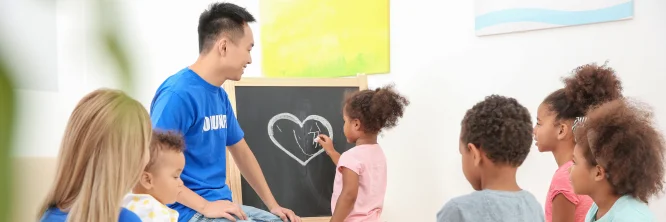
The teacher will be the most important socializing agent for children after parents and, as an authority figure, their teachings will have a lot of weight in the first years of life. Thus, the role of the teacher can be crucial for the future adult to promote equality in their environment.
How to avoid gender discrimination at school?
Gender stereotypes still persist in all areas of society. According to UNESCO reports, about half of men think that they would be better political leaders, and the “best” thing is that these thoughts have been founded since childhood.
To avoid them, it is essential to promote an inclusive and respectful environment, in which equal opportunities are promoted, non-sexist language and educational materials are used, and equal participation of all students is encouraged. The best way to avoid inequality is by challenging gender stereotypes and promoting empathy and mutual respect.
How can we promote gender equality at school?
In the 21st century and with access to education guaranteed to all children and young people, a survey carried out in 2022 by the Youth Barometer confirms that between 20% and 30% of students think that careers related to education or care are more suitable for women; while those that focus on science and technology are better for men. This widespread thinking is a clear example that there is still much to do in terms of gender equality in education.
To promote equality from the first educational stages, different initiatives can be carried out.
Promote inclusive education
Committing to the inclusion of diverse student profiles is essential. This involves adapting the educational environment so that all students, regardless of their abilities or disabilities, have access to quality education.
Help create a diverse resume
The school curriculum must reflect the diversity of society, including gender, ethnic, cultural and social perspectives. Texts and materials that represent a wide range of identities and experiences should be included.
Develop awareness and training plans
Educators must receive training on equality and diversity issues to be able to address them effectively in the classroom. This includes promoting empathy and respect for differences.
Use inclusive language
Promote the use of inclusive language that does not reinforce gender stereotypes or discrimination. This involves using gender-neutral language and being aware of the words and phrases you use.
Inclusive extracurricular activities
Conduct extracurricular activities that encourage the participation of all students, regardless of their abilities or interests. This can include sports, art, music, and diversity clubs.
Offer mentoring and support
Establish mentoring programs between students of different ages to promote mutual support and the development of social skills. Additional resources can also be provided for those who need additional support.
Promotion of non-traditional gender roles
Encourage the exploration of non-traditional interests and gender roles. This may include presenting role models who challenge gender stereotypes in professions and activities.
Parent involvement
Involve parents in their children’s education and encourage open communication between school and home. Parents can play an important role in promoting values of equality.
Evaluation and monitoring of executed actions
Constantly monitor progress in promoting equality in education. This involves collecting data on student performance and school climate and using it to make informed decisions.
Celebration of diversity
Organize events and activities that celebrate cultural, ethnic and gender diversity. This helps create an inclusive and positive school environment.
You can also read about the following topics: